

Design Timeless Bathroom Tile: A Step-by-Step Guide
Table of Contents
Understanding What Makes Bathroom Tile Timeless Why Timelessness Matters for Resale Value
Why Timelessness Matters for Resale Value
Neutral Bathroom Tile Colors That Never Go Out of Style How Lighting Impacts Tile Perception
How Lighting Impacts Tile Perception
Classic Bathroom Tile Ideas: Patterns and Shapes Subway Tile, Hexagon, and Geometric Patterns Herringbone and Greek-Key Borders
Subway Tile, Hexagon, and Geometric Patterns
Herringbone and Greek-Key Borders
Durable Bathroom Tile Options: Material Selection Porcelain vs. Ceramic vs. Natural Stone Marble-Effect and Honed Stone Finishes
Porcelain vs. Ceramic vs. Natural Stone
Marble-Effect and Honed Stone Finishes
Choosing Grout for Timeless Tile: Color and Maintenance Matching vs. Contrasting Grout Lines Long-Term Grout Maintenance
Matching vs. Contrasting Grout Lines
Long-Term Grout Maintenance
Step-by-Step: How to Design Timeless Bathroom Tile Step 1: Define Your Neutral Foundation Step 2: Select Your Tile Pattern and Shape Step 3: Coordinate with Countertops and Flooring Step 4: Plan for Grout Color and Installation Precision Step 5: Consider Texture Layering and Visual Balance
Step 1: Define Your Neutral Foundation
Step 2: Select Your Tile Pattern and Shape
Step 3: Coordinate with Countertops and Flooring
Step 4: Plan for Grout Color and Installation Precision
Step 5: Consider Texture Layering and Visual Balance
Common Mistakes That Date Your Bathroom Tile Design
Budget-Friendly Tips for Timeless Tile Without Compromise
Design Timeless Bathroom Tile: A Step-by-Step Guide
Last Updated: July 31, 2026
Learning how to design timeless bathroom tile is one of the most important decisions you'll make during a bathroom renovation. At TRC Home Improvement, we've spent over 30 years helping homeowners in Fort Mill, Rock Hill, and surrounding NC/SC areas create bathrooms that look stunning today and won't feel dated in five years. The difference between a bathroom that ages gracefully and one that screams "2026" often comes down to deliberate choices about color, pattern, material, and finishing details.
Understanding What Makes Bathroom Tile Timeless
Timeless bathroom tile relies on neutral foundations, geometric patterns that feel architectural rather than trendy, and high-quality materials that age beautifully. Classic approaches, subway tile in matte finishes, hexagon patterns, marble-effect porcelain, herringbone layouts, and subtle Greek-key borders, have proven their staying power over 50+ years and will remain appropriate for decades to come.
Pro Tip The single best predictor of whether a tile design will age well is whether it would have looked good 15 years ago. If you're drawn to a pattern because it's trendy right now, it will likely feel dated quickly.
Why Timelessness Matters for Resale Value
Buyers notice bathrooms immediately. A dated bathroom signals potential updates needed elsewhere, while timeless tile becomes a selling point. Property owners and realtors in the Charlotte metro area have seen this repeatedly: homes with neutral, classic bathroom tile sell faster and command higher prices than those with bold or trendy finishes.
For rental property owners managing multiple units, timeless tile is an operational advantage. Tenants accept neutral bathrooms without complaint, and you avoid replacing trendy tile every 5-7 years.
Neutral Bathroom Tile Colors That Never Go Out of Style
The foundation of any timeless bathroom tile design is color. Whites, creams, soft grays, and warm beiges reflect light, making bathrooms feel larger and cleaner while pairing seamlessly with any future design changes.
Soft gray has emerged as the most versatile neutral for contemporary bathrooms. It bridges traditional and modern aesthetics without feeling cold or dated. Black and dark charcoal can also be timeless, but only as accent elements, not dominant colors.
Watch Out Avoid heavily saturated colors like seafoam, blush pink, or sage green in large quantities. These trend-driven colors date quickly. If you love a specific hue, use it in small doses where it can be easily changed without replacing tile.
How Lighting Impacts Tile Perception
The same tile can look completely different depending on how light hits it. Matte and honed finishes appear softer under bright bathroom lighting, while glossy finishes reflect light dramatically and can emphasize installation imperfections.
In bathrooms with limited natural light, lean toward warmer neutrals and matte finishes. With abundant natural light, you have more flexibility. LED lights with a color temperature of 3000-4000K are ideal for bathrooms, as they don't distort tile color.
Test your tile selection in your actual bathroom lighting before committing. Ask for a sample to take home and view it at different times of day.
Classic Bathroom Tile Ideas: Patterns and Shapes
Once you've settled on a neutral color, add visual interest through pattern and shape while maintaining timelessness.
Subway Tile, Hexagon, and Geometric Patterns
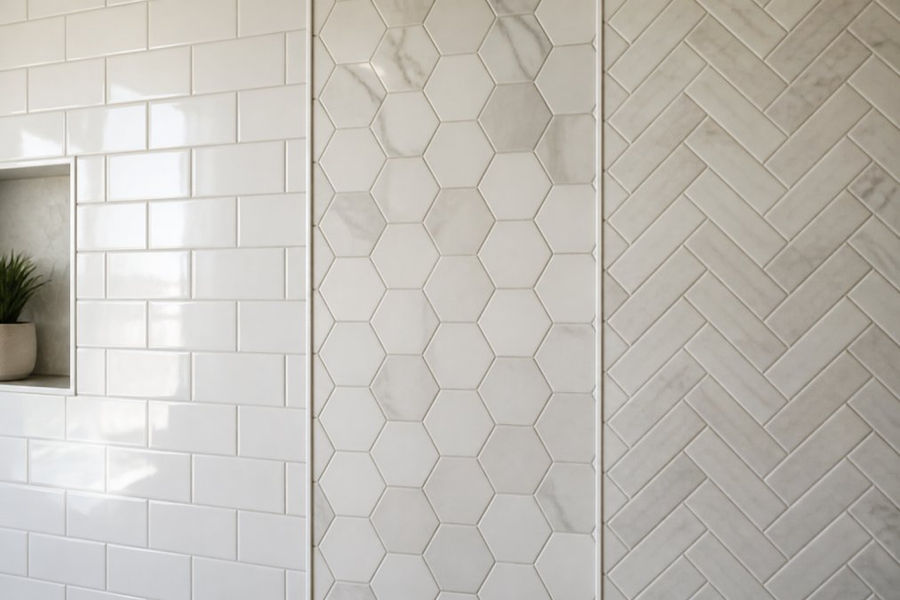
Subway tile is the workhorse of timeless bathroom design. A 3-by-6-inch white or light gray subway tile in a running bond pattern has been standard since the early 1900s and works on shower walls, backsplashes, and floor accents.
Hexagon tile offers a subtle geometric step up from subway. Small hexagons (1-2 inches) feel delicate; larger hexagons (4-6 inches) feel bolder. Stick with neutral colors and matte finishes for maximum timelessness.
Larger square tiles (8-by-8 or 12-by-12 inches) in neutral tones are also timeless, especially in simple grid patterns. Avoid small mosaics unless they're part of a traditional Greek-key or geometric border.
Herringbone and Greek-Key Borders
Herringbone patterns, where rectangular tiles are laid at 45-degree angles in alternating directions, add movement without feeling dated. A herringbone accent wall or floor border in neutral tile is a sophisticated choice that has remained popular for decades.
Greek-key borders work well as a trim detail between wall tile and different materials, or as a small accent strip. Use a Greek-key border as a single accent element, not on multiple walls.
Durable Bathroom Tile Options: Material Selection
Durability is inseparable from timelessness. A beautiful tile that cracks, stains, or requires constant maintenance will feel dated faster than a humble tile that performs flawlessly for 20 years.
Porcelain vs. Ceramic vs. Natural Stone
Porcelain is the most durable and practical choice for bathroom tile. It's denser than ceramic, absorbs less water, and resists staining and etching. Porcelain also comes in marble-effect and stone-look finishes that mimic natural materials at a fraction of the cost and maintenance burden.
Ceramic tile is less durable than porcelain and more prone to chipping, but works well for shower walls and smaller bathrooms. Natural stone offers authentic beauty and timeless appeal but requires sealing, is prone to staining and etching, and demands more maintenance than porcelain. For most bathrooms, porcelain that mimics stone offers 95% of the visual appeal with 10% of the maintenance.
Marble-Effect and Honed Stone Finishes
Marble-effect porcelain gives you the visual luxury of real marble without the maintenance headache. Modern printing technology makes marble-effect tile nearly indistinguishable from real marble at a glance.
Honed stone finishes, whether real stone or porcelain, have a matte, slightly textured surface that feels more refined than polished tile. Honed finishes also hide water spots and soap residue better than glossy finishes. Matte finishes in general age better, show fewer imperfections, and feel less trendy than high-gloss tile.
Key Takeaway Porcelain in a matte or honed finish, in neutral colors, with subtle stone-like veining, is the most durable and timeless choice for bathrooms. It performs well, ages beautifully, and won't require replacement due to damage or staining.
Choosing Grout for Timeless Tile: Color and Maintenance
Grout has a massive impact on how tile looks and ages. The wrong grout choice can make a timeless tile design look dated or dingy within a few years.
Matching vs. Contrasting Grout Lines
Matching grout, where the grout color closely matches the tile, creates a seamless, cohesive look that minimizes grout lines visually and makes the space feel larger. Matching grout works well for subway tile, hexagon, and larger format tiles in neutral colors.
Contrasting grout, typically dark gray or charcoal against light tile, emphasizes the geometric pattern and adds visual interest. However, contrasting grout requires perfect installation and maintenance, as any unevenness becomes obvious. For timeless design, matching grout is generally the safer choice.
Long-Term Grout Maintenance
Grout is porous and stains easily. In bathrooms with high moisture, mold and mildew can develop in grout lines if the bathroom isn't properly ventilated. Epoxy grout resists staining and mold better than traditional cement grout, but is more difficult to install and repair.
Seal your grout within a few weeks of installation and re-seal every 1-2 years. This simple maintenance step prevents staining and extends the life of your grout dramatically. Light gray or off-white grout is more forgiving than pure white, hiding minor discoloration while appearing clean and bright.
Step-by-Step: How to Design Timeless Bathroom Tile
Step 1: Define Your Neutral Foundation
Start by choosing your dominant color, typically a neutral white, cream, soft gray, or warm beige that covers 70-80% of your visible tile surface. Visit multiple tile showrooms and view samples in your actual bathroom lighting at different times of day. Once you've chosen your dominant color, stick with it.
Step 2: Select Your Tile Pattern and Shape
With your color locked in, choose a pattern. For most bathrooms, simple geometric patterns work best: subway tile in a running bond, hexagon tile in a grid, or larger squares in a simple layout. If you want more visual interest, consider a herringbone accent wall or a subtle border detail, but limit yourself to one accent pattern per bathroom.
The shape of your tile should match the scale of your bathroom. Small tiles (1-2 inches) can feel fussy in a large bathroom, while large tiles (12+ inches) can feel overwhelming in a small space. Medium-sized tiles (3-6 inches) work well in most bathrooms.
Step 3: Coordinate with Countertops and Flooring
Your bathroom tile needs to work with your countertop material, floor tile, and vanity finish. If your countertop is a busy pattern or bold color, keep your wall tile simple and neutral. If your floor tile is patterned, your wall tile should be solid. The goal is visual balance with enough interest to feel intentional, but not so much that the space feels chaotic.
Step 4: Plan for Grout Color and Installation Precision
Before ordering tile, decide on grout color. Matching grout creates a seamless look; contrasting grout emphasizes pattern. For timeless design, matching or subtle gray grout is safer than dark contrast.
Plan for installation precision. Uneven grout lines, misaligned tiles, and poor layout planning will make even a timeless tile design look amateur. Hire a licensed, experienced tile installer, especially for pattern work like herringbone or Greek-key borders.
At TRC Home Improvement, our fully licensed team in NC and SC understands that installation precision is non-negotiable for timeless results. We use advanced waterproofing techniques and careful layout planning to ensure your tile work looks polished and professional.
Step 5: Consider Texture Layering and Visual Balance
Texture adds depth to a bathroom without introducing color or pattern. A matte subway tile feels different from a honed marble-effect tile, even if they're the same color. Consider mixing matte and slightly textured finishes to add visual interest. Avoid mixing too many different finishes; stick to two or three complementary textures.
Also think about visual weight. Dark colors feel heavier than light colors. If you use a darker accent color or darker grout, balance it with lighter tile elsewhere to keep the space feeling open.
Common Mistakes That Date Your Bathroom Tile Design
The most common mistake is using trendy colors or patterns. Seafoam tile, rose gold accents, and heavily patterned geometric designs feel very 2020s and will scream "dated" in five years. Stick with neutrals as your foundation, and add trendy elements through removable décor, not permanent tile.
Another mistake is poor installation. Uneven grout lines, misaligned tiles, and visible caulk gaps make even beautiful tile look sloppy. Mixing too many materials and finishes creates visual chaos. Finally, neglecting maintenance dooms even a timeless design. Unsealed grout stains, hard water deposits build up, and mold grows in poorly ventilated bathrooms.
Budget-Friendly Tips for Timeless Tile Without Compromise
Timeless design doesn't require a luxury budget. Porcelain in simple geometric patterns, subway, hexagon, larger squares, is inexpensive and durable. You don't need expensive imported tile or rare natural stone to achieve a timeless look.
Focus your budget on areas that matter most. Shower walls and the area behind the vanity are the most visible; invest in quality tile and professional installation there. Less visible areas can use more budget-friendly options without compromising overall design.
Consider using marble-effect porcelain instead of real marble. You get the visual impact at 50-60% of the cost with far less maintenance. Labor costs often exceed material costs, so get multiple quotes from licensed installers.
Pro Tip Invest in professional waterproofing for shower installations. Poor waterproofing leads to mold, rot, and expensive repairs. Quality waterproofing is the foundation of a bathroom that will last 20+ years without major issues.
Designing a bathroom that stays beautiful for decades requires resisting trends, choosing durable materials, and committing to thoughtful installation. Timeless design is also practical and affordable, you don't need luxury materials or complicated patterns to achieve it.
If you're planning a bathroom renovation in Fort Mill, Rock Hill, Mathews, Mint Hill, Indian Trail, Pineville, Ballantyne, Waxhaw, or surrounding areas, TRC Home Improvement can help. Our team specializes in custom tiled walk-in showers and seamless tub-to-shower conversions with over 30 years of hands-on experience. We provide free no-pressure design consultations where we'll help you select tile, plan your layout, and ensure your installation is done with precision and advanced waterproofing techniques. Contact us today for a free estimate and discover how we can transform your bathroom into a timeless sanctuary.
National Association of Home Builders Remodeling Market Report
Tile Council of North America Installation Standards
Design Element | Timeless Choice | Why It Works | Maintenance Level |
Primary Color | Neutral gray, white, or cream | Works with any décor, reflects light, ages well | Low |
Tile Shape | Subway, hexagon, or large square | Proven geometric appeal, easy to install | Low |
Pattern | Running bond or simple grid | Architectural, not trendy, hides imperfections | Low |
Finish | Matte or honed | Hides water spots, feels refined, ages beautifully | Low |
Grout Color | Matching or subtle gray | Minimizes visual clutter, forgiving of staining | Medium |
Material | Porcelain or quality ceramic | Durable, stain-resistant, long-lasting | Low |
Accent Elements | Single herringbone wall or border | Adds interest without overwhelming | Medium |
Frequently Asked Questions
What makes a bathroom tile design truly timeless?
Timeless bathroom tile relies on neutral color palettes, classic patterns like subway tile or geometric shapes, and durable materials such as porcelain or honed stone. Avoid high-contrast or trendy color combinations, and focus on architectural balance with simple grout lines. Quality installation and proper maintenance also ensure your design withstands decades of use without appearing dated.
How do I choose neutral bathroom tile colors that work with my lighting?
Neutral bathroom tile colors, whites, grays, beiges, and soft taupes, appear different under various lighting conditions. Natural light brightens cool tones, while warm artificial light enhances warmer neutrals. Visit showrooms under both daylight and evening lighting to preview how your tile selection will look in your actual bathroom. Matte finishes reduce glare and appear more sophisticated than glossy tiles.
Is subway tile still considered timeless, or has it become dated?
Subway tile remains timeless when paired with a neutral color palette and simple, consistent grout lines. The key is avoiding trendy installation angles or colored grout. Classic 3x6 subway tile in white or light gray, installed traditionally with matching grout, has proven its longevity across decades. Pair it with quality porcelain and proper waterproofing for lasting appeal.
What grout color should I choose to keep my tile design timeless?
Matching grout, where grout color blends with tile color, creates a clean, monochromatic look that feels contemporary and timeless. Contrasting grout (dark grout on light tile or vice versa) emphasizes grout lines and can feel dated quickly. Choose grout specifically formulated for bathrooms to minimize maintenance, and plan for regular sealing every 1-3 years to prevent discoloration and water damage.
This article was written using GrandRanker


Comments