

Best Bathroom Flooring for High Humidity
Table of Contents
Why High Humidity Demands Specific Flooring Choices
Porcelain Tile Bathroom Flooring: Durability and Water Resistance
Slip Resistance and Surface Texture
Installation and Maintenance Considerations
Waterproof Bathroom Flooring: Luxury Vinyl Options
SPC and WPC Vinyl: Core Differences
Best Bathroom Flooring for Moisture: Ceramic Tile and Other Materials
Ceramic Tile vs. Porcelain: What Matters
Installed Cost and Lifecycle Value
When Engineered Hardwood and Laminate Fall Short
Bathroom Humidity Control: Subfloor Prep and Waterproofing
Waterproof Product vs. Waterproof Assembly
Moisture Testing and Subfloor Preparation
Ventilation and Condensation Management
Comparison Table: Flooring Performance in High Humidity
Making Your Choice: Bathroom Flooring for High Humidity
Frequently Asked Questions
Last Updated: October 12, 2026
Why High Humidity Demands Specific Flooring Choices
Bathrooms are moisture battlegrounds. Steam, condensation, and standing water create an environment where ordinary flooring fails. The best bathroom flooring for high humidity isn't about aesthetics, it's about survival. Materials that work in dry rooms absorb moisture, warp, and develop mold within months in a humid bathroom.
At TRC Home Improvement, we've spent over 30 years watching flooring choices make or break bathroom renovations. The difference between a bathroom that thrives and one that deteriorates often comes down to one decision made before installation begins.
High humidity creates three threats to flooring: moisture absorption, dimensional instability, and microbial growth. Some materials expand when wet, causing buckling; others trap moisture underneath, leading to hidden subfloor rot. The best bathroom flooring for high humidity resists all three.
Porcelain Tile Bathroom Flooring: Durability and Water Resistance
Porcelain tile is the industry standard for high-humidity bathrooms. Unlike ceramic, porcelain is fired at higher temperatures, creating a denser material that absorbs virtually no water, making it the most reliable choice where moisture is constant.
Porcelain remains dimensionally stable regardless of humidity, so no cupping, warping, or separation from the substrate.
Porcelain also resists staining, scratching, and chemical damage. It needs no sealing, won't fade in sunlight, and handles the thermal cycling of heated floors. For rentals or high-traffic family bathrooms, that resilience means lower maintenance costs and longer replacement intervals.
Slip Resistance and Surface Texture
Material choice here is a safety decision. Wet bathroom floors are slippery, and porcelain can be dangerously so with the wrong finish, especially for elderly homeowners or anyone with mobility concerns.
Choose textured or matte-finish porcelain. Textured surfaces, matte glaze, structured pattern, or embedded grit, interrupt water flow and provide traction.
Prioritize anti-slip finishes over polished or glossy options. The aesthetic trade-off is minimal, modern textured porcelain comes in dozens of colors and patterns, and the safety gain is substantial.
Installation and Maintenance Considerations
Installation quality determines performance. Improper installation traps moisture beneath the tile, creating the exact problem you're avoiding. The substrate must be stable, level, and waterproofed before any tile is laid.
Maintenance is simple: mild soap and water, no sealing. Grout lines are the vulnerability, they absorb moisture and harbor mold if unsealed. Epoxy grout resists moisture better than cement-based grout and is worth the extra cost. Seal all grout lines after installation and inspect annually.
Waterproof Bathroom Flooring: Luxury Vinyl Options
Luxury vinyl has transformed bathroom flooring. Modern LVP and LVT are engineered to handle moisture better than almost any resilient option, waterproof by design, not just water-resistant, so they handle standing water without degradation.
The appeal is practical: softer and warmer underfoot than tile, easier to install, and forgiving, damage one plank and you replace just that plank. For homeowners wary of renovation disruption, luxury vinyl balances durability and simplicity.
SPC and WPC Vinyl: Core Differences
Not all luxury vinyl is equal. The core material determines moisture performance, and SPC (stone-plastic composite) and WPC (wood-plastic composite) behave differently in humid environments.
SPC vinyl uses a rigid stone-based core that's completely waterproof, it doesn't swell, shrink, or absorb moisture under any conditions. That rigidity makes it more stable than WPC and able to handle standing water indefinitely without warping. Choose SPC in extreme humidity or where splashing is frequent.
WPC vinyl uses a softer, wood-based composite core. It's waterproof but can swell slightly under prolonged moisture. It performs well in a typical, well-ventilated bathroom; SPC is safer where standing water or extreme condensation occurs.
The practical difference: if water regularly pools on the floor or your shower lacks a proper curb, SPC is worth the premium. If moisture is well managed, WPC performs excellently at a lower price.
Best Bathroom Flooring for Moisture: Ceramic Tile and Other Materials
Ceramic tile remains popular, with caveats. It's less dense than porcelain, so it absorbs more moisture, a real risk in high-humidity environments, where it develops problems porcelain won't.
The trade-off is cost: ceramic is cheaper, and some homeowners accept the shorter lifespan. But in a primary bathroom or rental where durability matters, porcelain is the better investment, the cost difference is often recouped within a few years through avoided repairs.
Ceramic Tile vs. Porcelain: What Matters
The fundamental difference is firing temperature and density. Porcelain is fired hotter, creating a non-porous surface; ceramic is fired lower and stays more porous. Both are durable, but porcelain resists moisture better.
In bathrooms this matters: ceramic can absorb moisture and trap it beneath the surface, feeding mold in the substrate, while porcelain's impermeability prevents it. Porcelain is the more reliable choice for a humid bathroom; ceramic works in dry or well-ventilated spaces but is a compromise in high humidity.
Installed Cost and Lifecycle Value
Material price per square foot is the number homeowners see first, and the most misleading. Installed cost (material plus labor, underlayment, membrane, grout, and setting materials) is what lands on the invoice, and the gap between materials narrows once installation is included.
Those are ranges, not quotes. Regional labor rates, bathroom size, and subfloor condition move the number significantly, a small bathroom with a difficult layout can cost more per square foot than a large, simple one.
Lifecycle value changes the picture. Porcelain over a waterproofed assembly commonly lasts 20 years or more with routine cleaning. SPC vinyl carries 10-to-20-year residential warranties, though real-world replacement often comes sooner in a heavily used primary bathroom. Ceramic sits in the middle, durable, but more prone to moisture-related grout and substrate issues than porcelain.
Compare cost per year of service, not per square foot. A porcelain floor costing 30% more upfront but lasting twice as long is the cheaper floor.
When Engineered Hardwood and Laminate Fall Short
Engineered hardwood and laminate are popular elsewhere but poor bathroom choices. Both have a plywood or composite base that swells with moisture. Engineered hardwood is more stable than solid, but still warps and cups in humid bathrooms, the material behaving as designed when the environment exceeds what it was built for.
Laminate is even more vulnerable: its particle board core absorbs moisture rapidly, expanding and buckling. Once water-damaged, replacement is the only option. Avoid both materials in bathrooms, upfront savings become expensive repairs later. Prioritizing durability requires selecting bathroom tile materials that resist saturation, such as the natural resilience found in mother of pearl.
One narrow exception: a powder room with no shower or tub, strong ventilation, and immediate spill cleanup. There, high-quality engineered hardwood or water-resistant laminate can survive, still a calculated risk, and not a recommendation for a full bathroom where humidity is high.
The lesson: stick with moisture-resistant materials designed for wet environments.
Bathroom Humidity Control: Subfloor Prep and Waterproofing
Material choice is only half the battle. What happens beneath the flooring determines whether moisture causes hidden damage, subfloor prep and waterproofing are where many renovations fail, even with the right material.
Waterproof Product vs. Waterproof Assembly
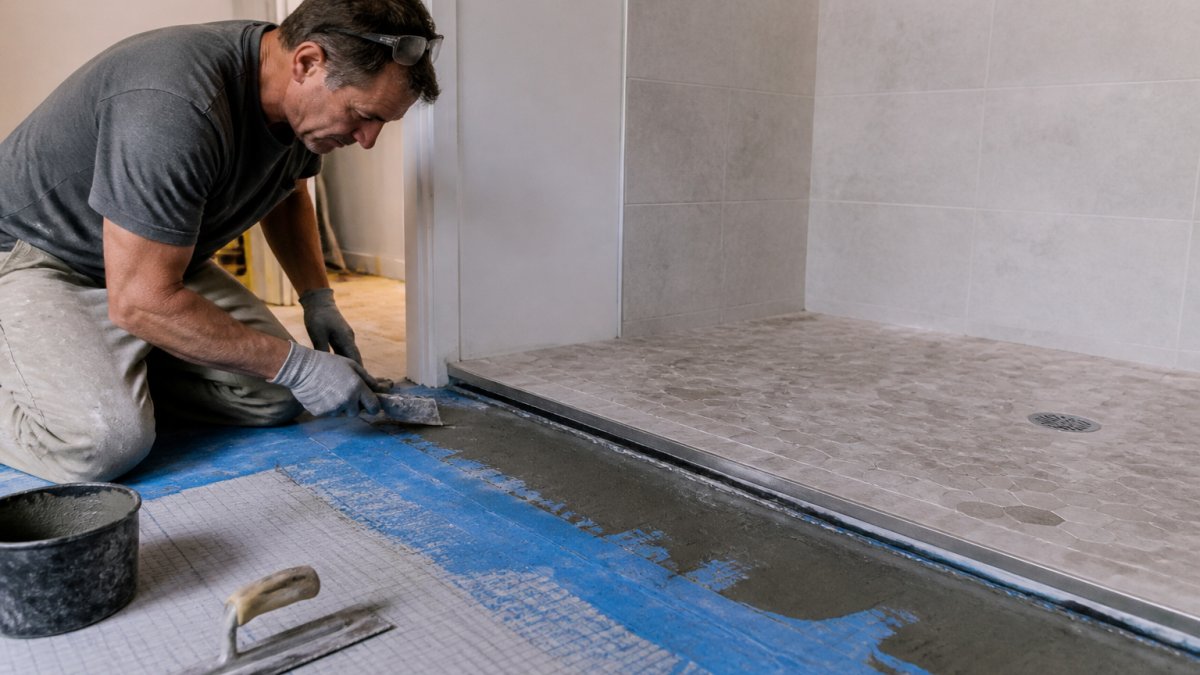
This is the most misunderstood point in bathroom flooring, and where most DIY installations and even some contractor jobs go wrong. A waterproof product does not make the floor waterproof. Porcelain is impervious, SPC vinyl fully waterproof, epoxy grout moisture-resistant, but water reaching the seams, perimeter, or subfloor doesn't care how waterproof the surface is.
A waterproof bathroom floor is an assembly, not a material. That assembly has four parts that all have to work together:
The surface material, tile, vinyl plank, or sheet vinyl. This is the part homeowners focus on, and it is usually the least likely to fail.
The underlayment or membrane, an uncoupling membrane, a bonded sheet waterproofing membrane, or a liquid-applied waterproof coating. This is what actually stops water from reaching the subfloor.
The seams and penetrations, every joint between membrane sheets, every pipe penetration, every drain flange, and every curb-to-floor transition. These are the failure points.
The perimeter and transitions, where the floor meets the wall, the tub, the shower curb, and the doorway threshold. Water migrates to these edges and wicks under the assembly if they are not sealed.
A common pattern: beautiful porcelain tile over a subfloor that was never waterproofed. It looks perfect for two or three years, then the subfloor swells, grout cracks, and the damage surfaces only when the floor moves underfoot. The tile was waterproof; the assembly was not.
Watch Out If your bathroom is on a second floor or over a finished ceiling, a failed floor assembly can cause thousands of dollars in damage to the rooms below before you notice anything wrong in the bathroom itself. Waterproofing the assembly is not optional in these locations.
Moisture Testing and Subfloor Preparation
A moisture test should be the first step in any bathroom renovation, yet many homeowners skip it and discover hidden problems after installation. Know what you're covering before you cover it.
If moisture is detected, identify and fix the source, improved ventilation, a leak repair, or exterior water intrusion. Let the subfloor dry completely before installation. Rushing this step is a common mistake; a wet subfloor will fail any flooring, however water-resistant.

Subfloor prep also means leveling and stabilization. An uneven subfloor cracks tiles, lifts vinyl, and fails grout, so level it before installation, an investment that pays off through years of trouble-free performance.
Ventilation and Condensation Management
Ventilation is often overlooked but as important as material selection. A poorly ventilated bathroom develops moisture problems regardless of flooring. Exhaust fans running during and after showers remove moisture before it condenses on surfaces and soaks into materials.
The standard recommendation is an exhaust fan rated for the bathroom's square footage, running 20-30 minutes after each shower. Many bathrooms have undersized or inconsistently used fans; upgrading makes a measurable difference.
Windows help but aren't sufficient alone, most bathrooms lack them, and opening one in winter isn't practical. Exhaust fans are the reliable solution. Pair good ventilation with proper material selection and moisture problems become rare.
Key Takeaway The order of operations matters: fix the moisture source, test and prepare the subfloor, waterproof the full assembly (membrane, seams, penetrations, perimeter), then install the surface material. Skipping any step in that sequence is what turns a good material choice into a failed floor.
Comparison Table: Flooring Performance in High Humidity
Material | Water Absorption | Slip Resistance | Durability | Maintenance | Best For |
Porcelain Tile | <0.5% | High (textured) | Excellent | Low | Primary bathrooms, high humidity |
SPC Vinyl | 0% | Moderate | Very Good | Low | Extreme humidity, standing water |
WPC Vinyl | <1% | Moderate | Good | Low | Standard bathrooms, good ventilation |
Ceramic Tile | 3-6% | Moderate | Good | Moderate | Secondary bathrooms, lower humidity |
Engineered Hardwood | High | Low | Fair | High | Not recommended for bathrooms |
Laminate | Very High | Low | Poor | High | Not recommended for bathrooms |
Making Your Choice: Bathroom Flooring for High Humidity
The best bathroom flooring for high humidity depends on your climate, moisture exposure, and budget. In consistently humid environments, porcelain tile is the most reliable choice: it resists moisture absorption, needs minimal maintenance, and lasts decades with proper installation.
If you prefer vinyl underfoot or need faster installation, SPC vinyl is next best, waterproof performance comparable to porcelain, easier installation, warmer feel. WPC works well with good ventilation and controlled humidity, at a cost savings versus SPC.
Ceramic tile is a compromise: cheaper than porcelain but higher maintenance and shorter lifespan in high humidity. Reserve it for secondary bathrooms or spaces with minimal moisture.
The foundation of any successful choice is proper subfloor preparation and ventilation. Material selection matters, but installation quality and moisture management matter more: a poorly installed porcelain floor will fail, while a well-installed, properly waterproofed luxury vinyl floor performs reliably for years.
When TRC Home Improvement handles a renovation, we start with moisture assessment, not material selection. We test the subfloor, address moisture sources, and ensure proper waterproofing before installation, preventing the hidden problems that destroy bathrooms. We then recommend flooring based on your humidity conditions, traffic patterns, and aesthetic preferences, so the result looks great and performs reliably in the high-humidity environment it's designed for.
Choosing the right bathroom flooring for high humidity protects your investment and prevents costly repairs. Porcelain tile and modern luxury vinyl are proven performers in moisture-prone environments, but material is only part of the equation, professional installation, proper waterproofing, and ongoing moisture management keep your bathroom beautiful and functional for decades. At TRC Home Improvement, we combine the right materials with expert installation and advanced waterproofing techniques to deliver bathrooms that last. Our free design consultations help you select the perfect flooring for your needs, and our fully licensed team in North and South Carolina ensures installation is done right the first time. Contact us today for a no-pressure estimate and discover how we can transform your bathroom into a durable, beautiful space.
Frequently Asked Questions
What type of flooring is best for high humidity areas?
Porcelain tile and luxury vinyl plank (LVP) with SPC cores are the top choices for high humidity bathrooms. Porcelain tile resists water absorption completely and won't warp, while SPC vinyl offers waterproof protection with a softer feel underfoot. Both handle moisture-prone conditions far better than laminate or solid hardwood, which absorb water and deteriorate quickly in humid environments.
Is porcelain tile better than vinyl flooring for a humid bathroom?
Both excel in humidity, but for different reasons. Porcelain tile is harder, more durable over decades, and naturally resists mold growth. Vinyl is softer, warmer to walk on, and easier to install, often at lower cost. Porcelain performs better long-term in high-moisture bathrooms; vinyl offers comfort and easier maintenance. Your choice depends on budget, style preference, and whether you prioritize durability or comfort.
What happens if I don't prepare the subfloor properly before installing bathroom flooring?
Improper subfloor preparation allows moisture to accumulate beneath the flooring, leading to mold growth, wood rot, and structural damage. Even waterproof flooring fails if the subfloor isn't moisture-tested and sealed first. Professional installation includes moisture testing and proper waterproofing of the subfloor to prevent hidden damage. This step protects both your flooring investment and your home's structural integrity.
Can luxury vinyl plank be used in a bathroom with high humidity?
Yes, luxury vinyl plank with an SPC (stone-plastic composite) core is fully waterproof and handles high humidity well. WPC (wood-plastic composite) vinyl is also waterproof but slightly less rigid than SPC. Both resist warping and mold when installed properly over a prepared subfloor. Avoid standard vinyl plank in bathrooms; only SPC or WPC vinyl designed for wet areas will perform reliably in high-humidity conditions.
Contact Us

Comments